Skip to content

Independent course guidance

Sailing Courses
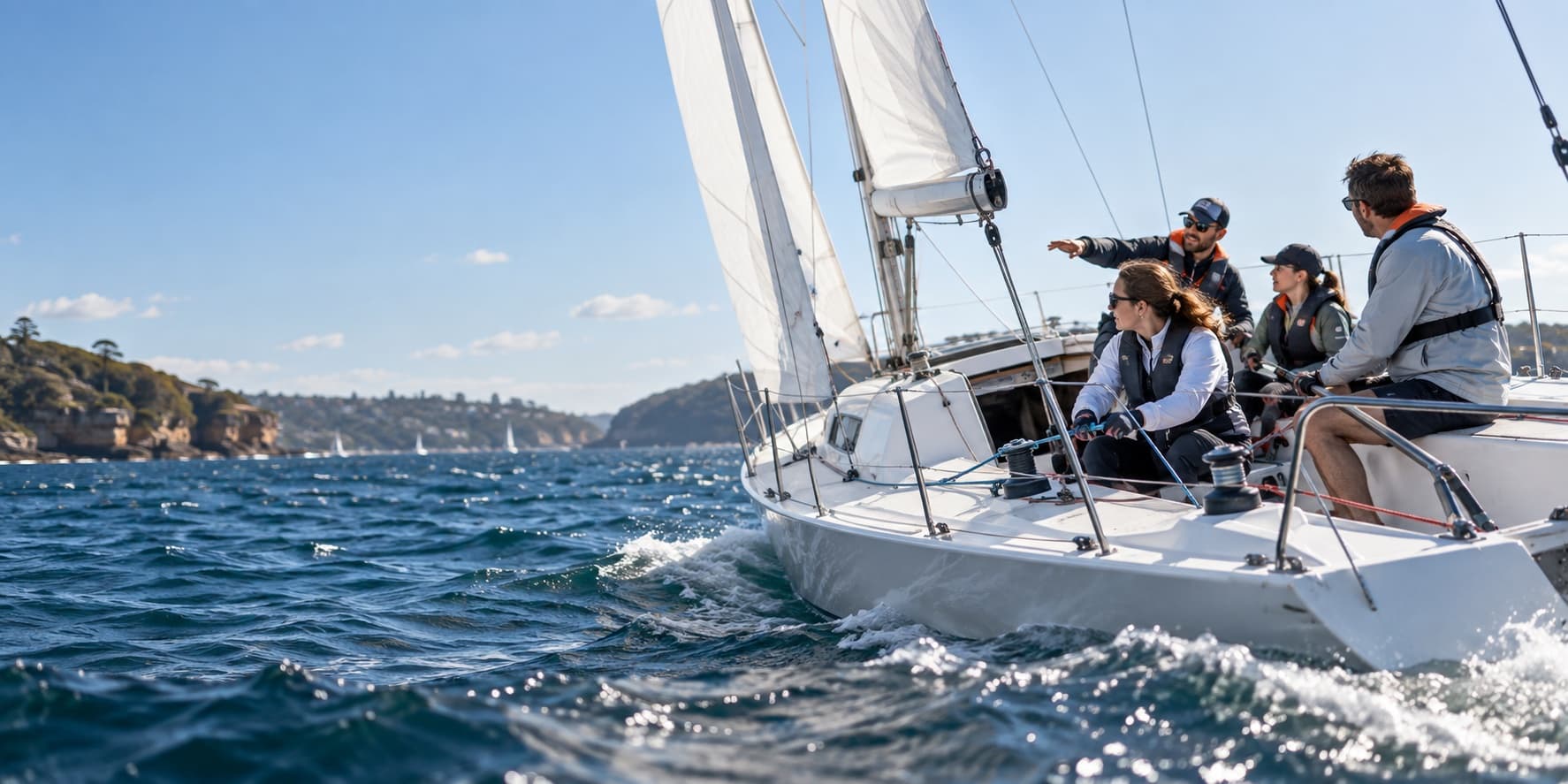
Adult students learning to sail a keelboat on an Australian harbour

Independent Australian sailing course guide · Reviewed October 2026

Find the right sailing course in Australia

Compare qualifications, course costs, legal requirements and schools without the sales pitch—from your first crew session to Yachtmaster Offshore.

IndependentNo affiliate linksAll 8 jurisdictions

Welcome to Sailing Courses

Listen to our introduction · 1 min 9 sec

Meet the School

Interviews with the people behind Australian sailing schools

Candid conversations about teaching, boats, qualifications and what students can expect on the water.

Mainstay Sailing sailing training in Airlie Beach, Whitsundays

Featured school

Mainstay Sailing

Airlie Beach, Whitsundays

In-depth interview with the Mainstay Sailing team, Airlie Beach

A sailing course that becomes a week of life aboard

Mainstay Sailing talks about liveaboard learning, its cruising yachts, RYA and Australian Sailing training, island navigation and building confidence at any age.

“A yacht works best when everyone understands that you’re a crew rather than a collection of individuals.”
  • Liveaboard learning
  • Whitsunday navigation
  • RYA pathways
Flying Fish Sailing sailing training in Middle Harbour, Sydney

Featured school

Flying Fish Sailing

Middle Harbour, Sydney

In-depth interview with Andy, Founder

From a first day on the harbour to a professional life at sea

Flying Fish began as a UK–Australia Yachtmaster programme and grew into a permanent Sydney training centre. Andy explains how beginners learn by doing, what makes Middle Harbour such a useful classroom, and why a Yachtmaster ticket is the start—not the end—of becoming a professional skipper.

“You don’t need to have grown up sailing, own a boat or know all the terminology before you start.”
  • First-time sailors
  • RYA Yachtmaster
  • Professional pathways
Adventure Sailing sailing training in Port Geographe, Western Australia

Featured school

Adventure Sailing

Port Geographe, Western Australia

In-depth interview with the Adventure Sailing team, Port Geographe

From family cruising to immersive learning at sea

Adventure Sailing explains how a family cruising chapter became a year-round school, what life is like on a liveaboard course, and how its 14-boat fleet supports recreational and commercial training.

“A typical day onboard starts with a swim and coffee.”
  • Liveaboard sailing
  • Geographe Bay
  • Commercial pathways

More schools to explore

Five more current provider profiles

These are live YouSail listing profiles—not interviews and not endorsements. Open each record to check published training, location and contact details.

New in-depth interviews will only be labelled as interviews after the school has supplied or approved its answers. We do not manufacture quotes from directory data.

0
Licences required to sail an engineless dinghy, anywhere in Australia
8
Jurisdictions with their own licensing rules — one of which issues none
2,500 nm
Sea miles behind an RYA Yachtmaster Offshore ticket
50%
Of a Sydney Hobart crew must hold a Safety and Sea Survival Certificate

How this works

How to choose a sailing course in Australia

Most confusion in Australian sailing training comes from comparing courses across systems as though the names meant the same thing. Sort the goal first.

01

Work out what you actually need

There is no single sailing licence in Australia. A dinghy needs no paperwork at all; a yacht with an auxiliary needs a state licence and a radio ticket. Start from the goal, not the course brochure.

Open the pathway picker →
02

Pick the system that travels where you do

Australian Sailing is cheaper and everywhere at home. RYA and IYT cost more and are recognised almost anywhere. NauticEd sells theory online with a practical sign-off.

Compare the four systems →
03

Get the miles, not just the certificate

Certificates are cheap next to sea miles. Crew every week, keep a logbook someone signs, and the qualifications follow far more easily than the other way around.

Build miles offshore →

A useful sequence

Certificates follow capability

Start with time on the water, add the legal tickets your boat needs, then choose higher qualifications only when your goal demands them.

  1. 01Try sailingDiscover day or crew session
  2. 02Build skillsCrew, helm and skipper
  3. 03Meet the rulesLicence, radio and safety
  4. 04Prove experienceLog miles and passages

Practical learning

Sailing theory and practical training

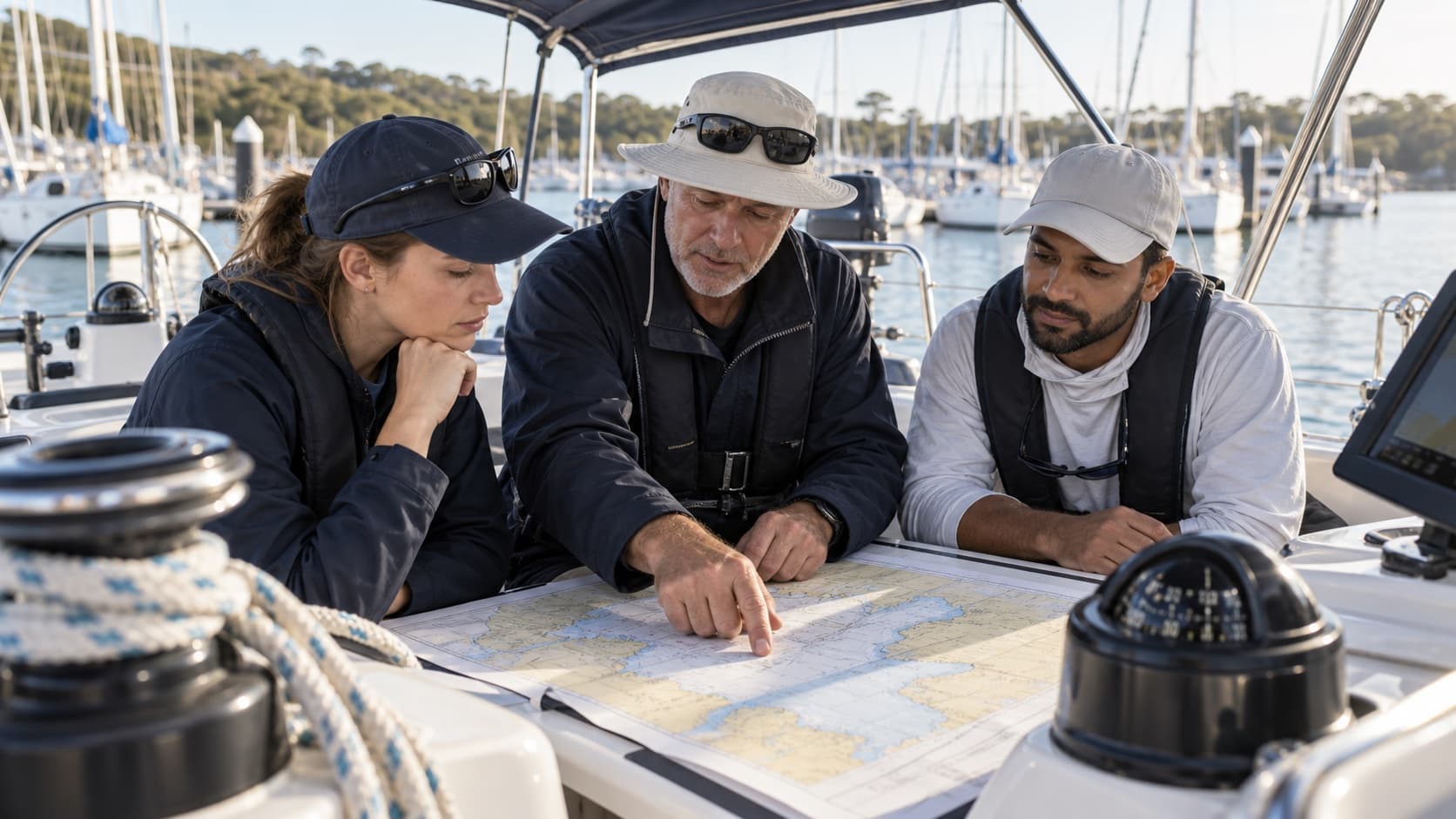
Navigation, weather and passage planning are not separate from sailing skill. Good instruction connects the chart, the forecast and the controls in front of you.

Sailing instructor and adult students studying a nautical chart aboard a training yacht in an Australian marina

Look for instruction that joins the pieces

  • Plan the trip, then compare the plan with what happens on the water.
  • Practise reefing, recovery and marina handling—not just talk about them.
  • Keep a signed logbook of days, miles, night hours and passages.
  • Debrief decisions as well as boat handling.

Where most people start

Australian Sailing keelboat course costs

Australian Sailing's adult keelboat courses are the spine of learning to sail here. Prices are indicative 2025–26 listings; clubs charge members less.

Australian Sailing

Start Crewing

Boat handling and safety as crew — winches, sail trim, terminology, moving around the boat safely.

Duration
12 hrs, usually two 6-hr days
Indicative
~$400–600
Australian Sailing

Start Helming

Boat control, points of sail, man-overboard recovery. Taking the tiller or wheel.

Duration
12 hrs
Indicative
~$400–600
Australian Sailing

Start Skippering

Australian Sailing's command course — unsupervised operation of a keelboat. The closest domestic equivalent to RYA Day Skipper.

Duration
Typically 2–4 days
Indicative
~$600–1,200
Australian Sailing

Safety and Sea Survival (SSSC)

The one offshore qualification with genuine teeth. Valid five years.

Duration
16 hrs — usually 9 hrs eLearning plus a practical day
Indicative
~$450–550
See all 60+ courses

Standards and recognition

Sailing qualification systems in Australia

Australia has no single training authority for recreational sailing. One domestic system, three imported ones, and a single club may teach more than one.

Domestic

Australian Sailing

Formerly Yachting Australia

The national federation and World Sailing member body. Runs the Discover Sailing brand and the national syllabus from Tackers through keelboat skippering.

Best for: Learning in Australia, club racing, kids, value for money

International

RYA

Royal Yachting Association (UK)

The global default for recreational and professional yacht qualifications. Separates shorebased theory from practical courses; Yachtmaster is an examination, not a course.

Best for: Chartering overseas, offshore, superyacht and professional work, the ICC

International

IYT Worldwide

International Yacht Training

RYA's main international competitor, with its own ladder from International Crew through Yachtmaster Ocean and Master of Yachts.

Best for: Bareboat charter credentials, a faster route than the RYA ladder

International

NauticEd

Online theory plus an in-water assessment, with a rank-and-level system tied to a self-reported electronic logbook.

Best for: Self-directed adults, cheap theory, charter-facing credentials

Compare all six in detail

Where to learn

Sailing regions and seasons in Australia

A beginner on Port Phillip in July and a beginner in Darwin in January face completely different problems. Southern states teach October to April; the tropics run May to October.

NSW

Sydney Harbour & Pittwater

The country's densest concentration of schools. A reliable nor'east sea breeze fills in around late morning through the warmer months and can build past 30 km/h on hot afternoons — enough to be exciting without being frightening. The harbour is sheltered enough that the Bureau issues a dedicated Sydney Enclosed Waters forecast covering the Harbour, Pittwater and Botany Bay.

VIC

Port Phillip Bay & the Gippsland Lakes

Port Phillip is a large semi-enclosed bay with a dependable summer sea breeze and clubs ringing it — Williamstown, St Kilda, Sandringham, Mornington, Geelong. Excellent all-round beginner water. Winter is cold enough that most learn-to-sail runs spring through autumn.

QLD

Moreton Bay, the Gold Coast & the Sunshine Coast

Warm water nearly year-round makes south-east Queensland a genuine four-season training ground. Moreton Bay is semi-enclosed and gentle, with real tidal range and serious bar crossings at its entrances — the Gold Coast Seaway and South Passage teach bar skills you can't learn on a lake.

QLD

The Whitsundays

Australia's charter capital and the single most popular place in the country to go from beginner to bareboat skipper in a week. The south-east trade winds firm up from April–May and define the season; April to September is prime, with July–September the most settled.

Before you pay

How to identify a good sailing course

Sailing instruction in Australia is accredited rather than licensed. Nobody from a government department inspects a sailing lesson — so judge the school yourself.

  • You steer within the first hour — sitting on a rail watching all day is a red flag on a paid course.
  • Briefing, activity, debrief, every session.
  • Man-overboard recovery practised repeatedly, under sail and under power.
  • Reefing in real breeze, not a dockside talk-through.
  • A signed logbook entry with miles, days and night hours.

Warning signs

  • A certificate promised regardless of performance.
  • Eight students on a 38-footer.
  • “Yachtmaster in two weeks” — arithmetically impossible for a beginner.
  • Pressure to book the whole ladder up front at a discount.
Ten questions worth asking →

Questions

Australian sailing course FAQs

Do I need a licence to sail a yacht in Australia?

Only because of the engine. Sailing itself is unlicensed everywhere in Australia. But almost every cruising yacht has an auxiliary, and operating a powered vessel requires a recreational boat licence in every state except the Northern Territory. Queensland and WA set the bar at 4.5 kW (6 hp), Tasmania at 4 hp, NSW at a 10-knot capability, and Victoria and South Australia at any motor at all.

What's the fastest way from zero to skippering my own boat?

An intensive commercial school: roughly four weeks and about $6,500 for a beginner-to-Day-Skipper fast track. Whether that makes you a competent skipper is a different question. Most experienced sailors would tell you the four weeks is the easy part and the following two seasons are what actually makes you safe.

Australian Sailing or RYA — which should I do?

Australian Sailing if you're learning and sailing in Australia: it's cheaper, it's everywhere, and the syllabus is good. RYA if you want a certificate that travels — overseas charter, offshore, professional work, or an ICC. Plenty of people do both, usually Australian Sailing first because it's a far cheaper way to find out whether you enjoy sailing.

Do I need a certificate to bareboat charter in the Whitsundays?

No. Queensland law doesn't require one and the major operators don't either. Instead you complete an online skills assessment before the charter, then a mandatory three-to-four-hour on-board briefing including a check sail. The briefer can refuse to hand over the boat if they're not satisfied. One operator puts it plainly: the Whitsundays is one of very few places in the world where a licence or formal experience isn't required. A certificate helps — it makes the briefing shorter and the operator more relaxed — but experience is what they're actually assessing.

Do I need a marine radio certificate for a private yacht?

Yes, if you use the VHF. The frequencies themselves are free under an ACMA class licence — no application, no fee — but that class licence carries a condition that the operator be qualified, or supervised by someone who is. The minimum is the Australian Waters Qualification (AWQ) for VHF within 12 nm. Most serious sailors go straight to the SROCP, and offshore sailors to the LROCP.

What's the difference between MROCP and LROCP?

Nothing — they're the same certificate under different names. The MROCP became the LROCP and the MROVCP became the SROCP back in 2015. The old names persist in race notices, club documents and instructors' habits. Certificates are issued for life by the Office of Maritime Communications at the Australian Maritime College.

All 30 questions

Still not sure where to start?

Go to a Discover Sailing Day at your nearest affiliated club. It costs nothing, it takes an afternoon, and it answers the only question that actually matters first — whether you enjoy being on a sailing boat. Everything in this guide is downstream of that.