07 — Geography
Where to learn sailing in Australia
Australia is not one sailing country. A beginner on Port Phillip in July and a beginner in Darwin in January are facing completely different problems.
- Southern states
- Main teaching season October to April
- Tropics
- Dry season, May to October
- Year-round
- Sydney, Perth and Brisbane
- Whitsundays
- April to September, best July–September
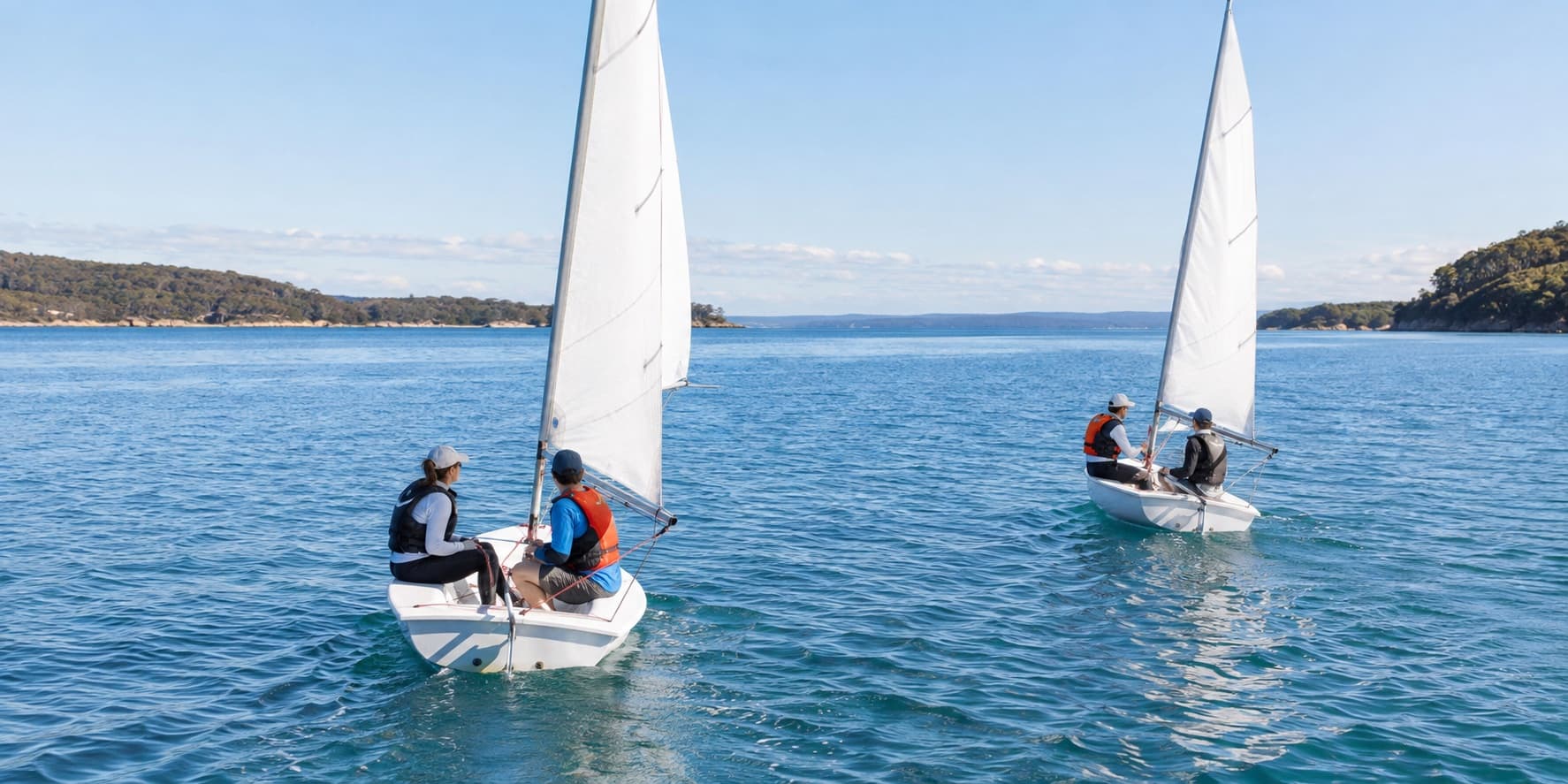
Protected water makes the first sessions simpler; frequent practice is what turns them into lasting skill.
Two rules cover most of it:
- Southern states — Victoria, Tasmania, South Australia, southern NSW — run their main teaching season from October to April, avoiding cold water and short days.
- Tropical regions — Queensland north of roughly Bundaberg, the Northern Territory, northern WA — run theirs in the dry season, May to October, avoiding cyclones, stingers and the wet-season build-up.
Sydney, Perth and Brisbane sit comfortably in between and teach close to year-round.
Sydney Harbour & Pittwater
The country's densest concentration of schools. A reliable nor'east sea breeze fills in around late morning through the warmer months and can build past 30 km/h on hot afternoons — enough to be exciting without being frightening. The harbour is sheltered enough that the Bureau issues a dedicated Sydney Enclosed Waters forecast covering the Harbour, Pittwater and Botany Bay.
The hazard to learn about: the southerly buster. A few times each spring and summer the wind swings from light north-west to a 60–70 km/h southerly within minutes, with a 15–20°C temperature drop. Sydney has taken this seriously since a semaphore warning system was installed in 1869. Any competent school will teach you to read the sky for it.
Pittwater is calmer and prettier and the standard choice for families. Both give easy access to open water outside the Heads when you're ready for it.
Port Phillip Bay & the Gippsland Lakes
Port Phillip is a large semi-enclosed bay with a dependable summer sea breeze and clubs ringing it — Williamstown, St Kilda, Sandringham, Mornington, Geelong. Excellent all-round beginner water. Winter is cold enough that most learn-to-sail runs spring through autumn.
The hazard: the Rip at Port Phillip Heads, where the entire bay drains through a narrow gap against ocean swell. Standing waves, ferocious tidal streams, and a long list of casualties. It is not beginner water and no school will take you near it.
The Gippsland Lakes — Paynesville, Metung — are flat, sheltered, swell-free and about as forgiving as Australian sailing gets. Ideal for nervous beginners and families, and home to a well-established charter fleet.
Moreton Bay, the Gold Coast & the Sunshine Coast
Warm water nearly year-round makes south-east Queensland a genuine four-season training ground. Moreton Bay is semi-enclosed and gentle, with real tidal range and serious bar crossings at its entrances — the Gold Coast Seaway and South Passage teach bar skills you can't learn on a lake.
The Whitsundays
Australia's charter capital and the single most popular place in the country to go from beginner to bareboat skipper in a week. The south-east trade winds firm up from April–May and define the season; April to September is prime, with July–September the most settled.
Cyclone season runs November to April with January–March the peak. Stinger season runs roughly October onward and operators make stinger suits mandatory. Short island hops, plentiful anchorages and warm water make it a gentle trade-wind classroom — which is exactly its limitation. You will not learn heavy weather here.
Swan River, Fremantle & the south-west
The Fremantle Doctor is the most dependable afternoon breeze in the country — a sea breeze that arrives mid-morning to early afternoon, strongest in December and January, starting west-south-west and backing south-west at its peak. It produces a clean two-part teaching day: sheltered river work in the light morning, then the Doctor in the afternoon once you can handle it. Geographe Bay and Bunbury offer gentler alternatives; Exmouth sits in the tropics and follows dry-season logic.
Gulf St Vincent & the Derwent
Adelaide's gulf waters are sheltered and under-used, with an established club training scene at North Haven and Outer Harbor. Port Lincoln punches well above its weight for junior sailing.
Hobart's Derwent gives sheltered, spectacular training water minutes from the city, with genuine four-season sailing if you can handle the cold. Step outside and you have Bass Strait and the D'Entrecasteaux — strong westerlies, big swell, fast-changing weather. Tasmania is the best place in Australia to build real heavy-weather competence, and the worst place to start from zero in July.
Darwin, Townsville & Cairns
Strictly a dry-season proposition, roughly May to October: steady south-east trades, low humidity, good visibility. The wet brings the build-up, monsoon and cyclone risk.
Two hazards that genuinely change how training runs up north: saltwater crocodiles in Darwin Harbour and NT waterways, and marine stingers — box jellyfish and Irukandji — along the north Queensland coast from about October to May. Capsize drills and in-water work are handled very differently here than in the south.
Lake Burley Griffin
Flat water, shifty breeze, no tide, no swell and no salt — an underrated place to learn dinghy sailing because the wind shifts force you to pay attention. Canberra Yacht Club and the university clubs are the hub. Under 10 knots you need no licence at all.
Choosing
Best sailing regions by training goal
- Absolute beginner: Gippsland Lakes, Pittwater, Moreton Bay, the Swan River, Lake Burley Griffin.
- Family holiday learning: The Whitsundays or the Gippsland Lakes.
- Building toward bareboat charter: The Whitsundays, because you'll be assessed and briefed in the waters you'll actually charter.
- Offshore and heavy weather: Tasmania and Bass Strait, the southern NSW open coast, or the Fremantle Doctor in open water.
- Bar crossings and tidal work: South-east Queensland.
Want local detail? Open the state-by-state sailing guides for seasons, first-course advice and licensing links in every jurisdiction.
08 — Vessels
Sailing training boats: dinghies, keelboats and yachts
The boat shapes the learning more than most beginners expect. A dinghy teaches feel — you're steering with your weight and the sail talks back instantly. A keelboat teaches systems and seamanship. Neither substitutes for the other, and the best sailors in any Australian club have usually done both.
Junior and learn-to-sail dinghies
- Optimist — the international junior single-hander, from about seven.
- Sabot — an Australian pram-bow design with a particularly strong following in Western Australia.
- Flying 11 — a NSW junior and youth two-hander, strongly associated with Hunter and Sydney clubs.
- Pacer — the stable, forgiving Australian two-person club trainer.
- RS Feva and RS Quest — modern boats steadily replacing older club fleets for youth and family training.
- ILCA / Laser — the standard single-hander once a sailor outgrows the entry boats.
- 420 and 29er — the youth high-performance classes feeding the Olympic pathway.
- Hobie 14, 16 and Wave — the off-the-beach catamaran route, big at Southport and other surf-coast clubs.
Training keelboats
- Elliott 5.9, 6m and 7 — the most common academy keelboat in Australia, small enough to feel responsive and big enough to teach crew work.
- J/24 — an established one-design with active Australian fleets.
- Beneteau First — accessible cruiser-racers used across club and commercial programs.
- SKUD 18 and Sonar — the adapted keelboats used in Sailability and Paralympic-pathway sailing.
- Farr 740 Sport — an Australian sportsboat, more a racing class than a training platform.
Cruising yachts
RYA and IYT courses in Australia run almost universally on Jeanneau, Beneteau and Bavaria monohulls between about 34 and 45 feet — the same boats you'll meet in a charter fleet anywhere in the world, which is a large part of the point. Expect wheel steering, a furling headsail, an inboard diesel and enough systems to give a maintenance course something to talk about.
Trailer sailers
MacGregor 26s, small Beneteau Firsts and a long tail of Australian designs. Rarely a formal training platform, frequently a first boat — cheap to own, no marina berth, and a genuinely practical way to convert lessons into miles.
Tall ships and sail training vessels
A distinct tradition, aimed mostly at youth development: Windeward Bound and Lady Nelson (Hobart), South Passage (Queensland), Leeuwin II (Fremantle), One & All (Port Adelaide), Enterprize (Melbourne), and James Craig (Sydney Heritage Fleet). STS Young Endeavour, the Navy-run national youth program, is mid-transition: the original 1987 brigantine is completing its final voyages through 2026 while a larger replacement built at Port Macquarie enters service. The program continues throughout — check the current voyage calendar before planning around a specific ship.
Catamarans — and why they need their own course
Lagoon, Leopard and Seawind dominate the Australian charter fleet, especially in the Whitsundays. A monohull ticket does not transfer cleanly, for reasons that are physical rather than bureaucratic:
- No ballast keel — stability and capsize behaviour are fundamentally different, and cats are reefed earlier and sailed more conservatively.
- Twin engines, so close-quarters handling is done on the throttles rather than by working a single prop and its prop-walk.
- Far greater beam, which changes every berthing approach and a lot of marina arithmetic.
- Almost no heel, so the feedback a monohull sailor relies on to sense being overpowered simply isn't there.
Accessible sailing
Pick your water, then pick your club
The directory lists clubs and schools in every state and territory, filterable by certification system.